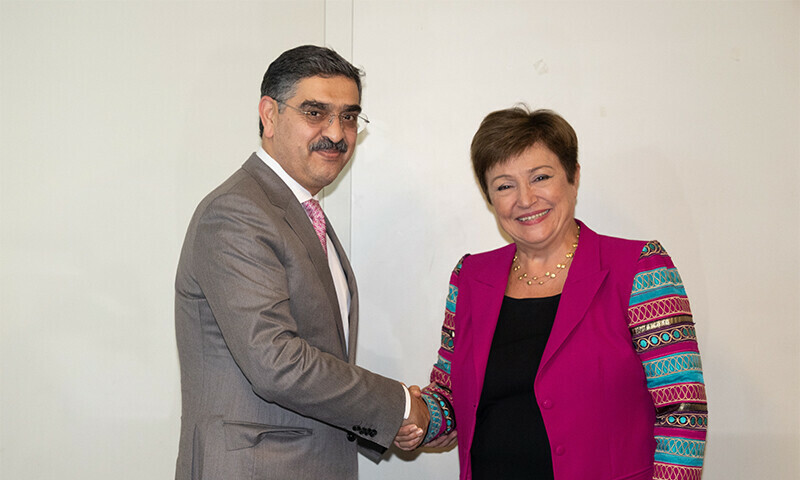
At a high-level meeting on the sidelines of UNGA 78, Pakistan’s caretaker prime minister briefed the IMF chief on economic stabilization measures as Georgieva stressed stronger revenue collection, sustainable growth and protection for the country’s most vulnerable.
By Saqib S. Qureshi
Senior Correspondent | A1 TV Pakistan
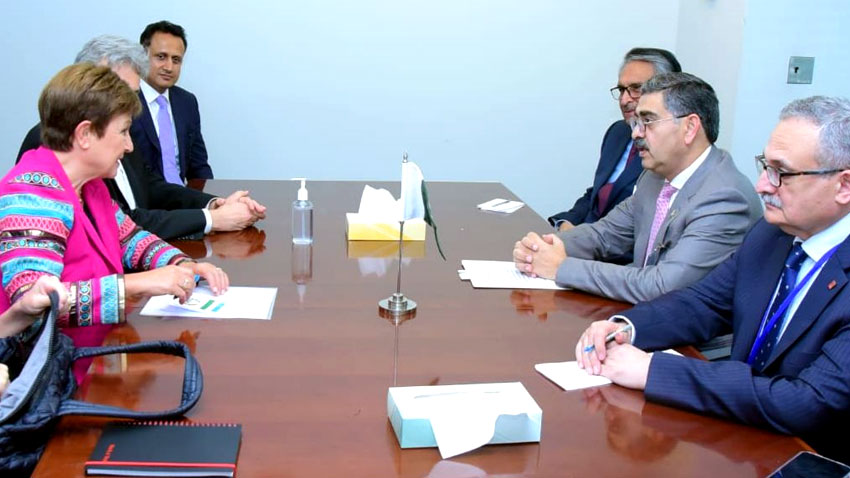
NEW YORK, Sept. 20, 2023 — Pakistan’s caretaker Prime Minister Anwaar-ul-Haq Kakar met International Monetary Fund Managing Director Kristalina Georgieva in New York on Wednesday for talks centered on Pakistan’s fragile economy, implementation of reforms and the country’s $3 billion IMF Stand-By Arrangement.
The meeting, held on the sidelines of the 78th United Nations General Assembly, came at a critical moment for Pakistan. The country had only months earlier narrowly moved away from the threat of sovereign default after securing the IMF agreement, while ordinary Pakistanis were confronting severe inflation, high energy costs and a sharp cost-of-living squeeze.
Kakar briefed Georgieva on measures being taken by his caretaker administration to stabilize and revive the economy.
According to Pakistan’s state news agency, the prime minister thanked the IMF for approving the $3 billion Stand-By Arrangement, saying government measures were intended to create conditions for sustainable economic growth and investment while protecting vulnerable sections of society.
Georgieva welcomed Pakistan’s efforts to implement reforms and assured Kakar of the IMF’s continued engagement with Islamabad.
But her message surrounding the meeting also went directly to one of Pakistan’s most politically sensitive economic questions: who should carry the burden of reform?
IMF’s Message: Tax the Wealthy, Protect the Poor
Following the meeting, Georgieva publicly emphasized that Pakistan needed stronger revenue collection without forcing its poorest citizens to carry a disproportionate share of the adjustment.
She summarized the IMF’s message in unusually direct terms: “collect more taxes from the wealthy” while protecting Pakistan’s poor.
The statement was significant because Pakistan’s IMF-backed stabilization program was unfolding amid widespread public frustration over inflation, electricity tariffs and petroleum prices.
Georgieva said Pakistan needed strong policies capable of securing stability and creating sustainable and inclusive economic growth, with revenue mobilization and protection of vulnerable citizens among the priorities.
For Pakistan, that meant the IMF relationship was no longer simply about obtaining emergency dollars.
It was increasingly about restructuring how the state raised revenue, managed expenditures and protected poorer households while restoring confidence in an economy that had moved dangerously close to a balance-of-payments crisis.
The $3 Billion Lifeline
The backdrop to the Kakar-Georgieva meeting was Pakistan’s $3 billion IMF Stand-By Arrangement.
The agreement had provided Islamabad with desperately needed financial breathing room after months of uncertainty over the country’s external financing requirements.
For Pakistan, an IMF agreement carried importance beyond the Fund’s own financing.
Continued IMF support could help restore confidence among other multilateral institutions, bilateral partners and investors that Islamabad remained committed to an agreed economic stabilization program.
But that support came with difficult policy choices.
Pakistan had been dealing with high inflation and pressure on its currency while reforms in the energy and fiscal sectors added to the economic strain felt by households.
Year-on-year inflation had reached 38 percent in May 2023 before easing to 27.4 percent in August, illustrating the severity of the cost-of-living crisis surrounding the UNGA meeting.
Kakar Defends the Stabilization Push
Kakar characterized his discussion with Georgieva as constructive and said it reinforced the two sides’ commitment to Pakistan’s economic stability and growth.
His government faced an unusual challenge.
As a caretaker administration preparing the country for elections, it nevertheless inherited an economic program requiring politically difficult decisions.
The government had to maintain IMF confidence while attempting to contain public anger over prices and utility costs.
That made the meeting in New York more than a routine diplomatic engagement.
It represented a direct conversation between Pakistan’s interim head of government and the institution whose support had become crucial to the country’s immediate economic stability.
IMF Signals Continued Engagement
Georgieva’s response provided Islamabad with an important signal.
She acknowledged Pakistan’s efforts to implement reforms and indicated that the IMF would remain engaged with the country.
At the same time, her emphasis on revenue collection made clear that continued stabilization would require domestic reforms rather than reliance solely on external financing.
The IMF chief’s insistence on protecting vulnerable citizens was equally important.
The economic adjustment facing Pakistan had generated a difficult policy dilemma: the government needed to reduce fiscal and external imbalances without worsening conditions for households already struggling with inflation.
Georgieva’s public position attempted to frame IMF-backed reform around a redistribution of that burden — increasing revenue from those with greater ability to pay while maintaining protection for poorer Pakistanis.
Why the Meeting Mattered
Among Kakar’s meetings during UNGA week, his engagement with Georgieva carried immediate consequences at home.
Pakistan’s relationship with the IMF affected the country’s reserves, investor confidence, access to external financing and the economic decisions confronting the caretaker government.
The meeting also exposed the central question facing Pakistan’s economic policymakers:
Could the government stabilize the economy without making the poorest Pakistanis pay the highest price?
For the IMF, the answer required stronger policies, higher revenue collection and protection of vulnerable citizens.
For Kakar’s government, the challenge was translating those objectives into policy while navigating inflation, public frustration and an approaching political transition.
The New York meeting did not eliminate those pressures.
But it demonstrated that Pakistan and the IMF intended to keep the stabilization program on course — and that the politically difficult debate over taxation, spending and who ultimately bears the cost of economic reform would remain at the heart of Pakistan’s recovery.