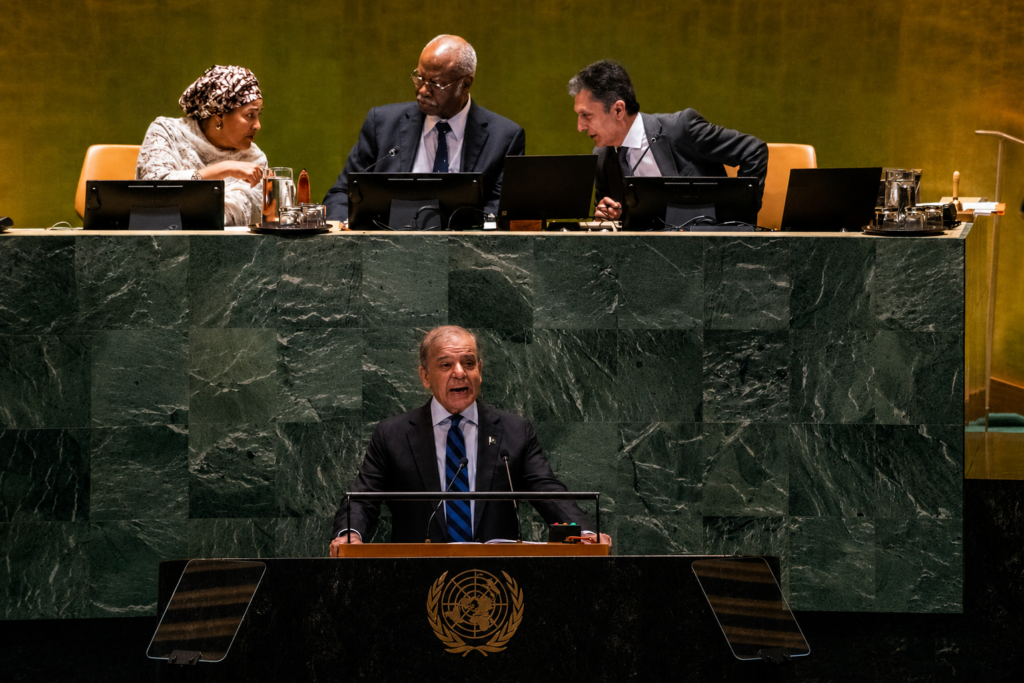
Prime Minister Shehbaz Sharif used talks with UN General Assembly President Philemon Yang to reaffirm Pakistan’s commitment to multilateral diplomacy as Islamabad prepared to begin a two-year term on the Security Council.
By Saqib S. Qureshi
Senior Correspondent, USA | A1 TV Pakistan
UNITED NATIONS, NEW YORK — September 2024 — Prime Minister Shehbaz Sharif met the president of the United Nations General Assembly, Philemon Yang, during his visit to New York, as Pakistan prepared to move from the wider UN membership into the organization’s most powerful decision-making chamber.
The engagement came during the high-level week of the 79th UN General Assembly, where Shehbaz led Pakistan’s delegation through a packed schedule of speeches, bilateral meetings and economic diplomacy.
But Pakistan arrived in New York with an additional source of diplomatic weight.
Just months earlier, the country had been elected as a non-permanent member of the UN Security Council for 2025-2026, winning 182 votes in the 193-member General Assembly. Pakistan was set to take its seat on January 1, 2025, replacing Japan in the Asian seat.
That made Shehbaz’s engagement with Yang more consequential than a routine meeting with the General Assembly leadership.
Pakistan was preparing to gain a direct role in Security Council deliberations over wars, sanctions, peacekeeping operations and threats to international security — at a time when the UN system was under enormous pressure from conflicts in Gaza, Ukraine and elsewhere.
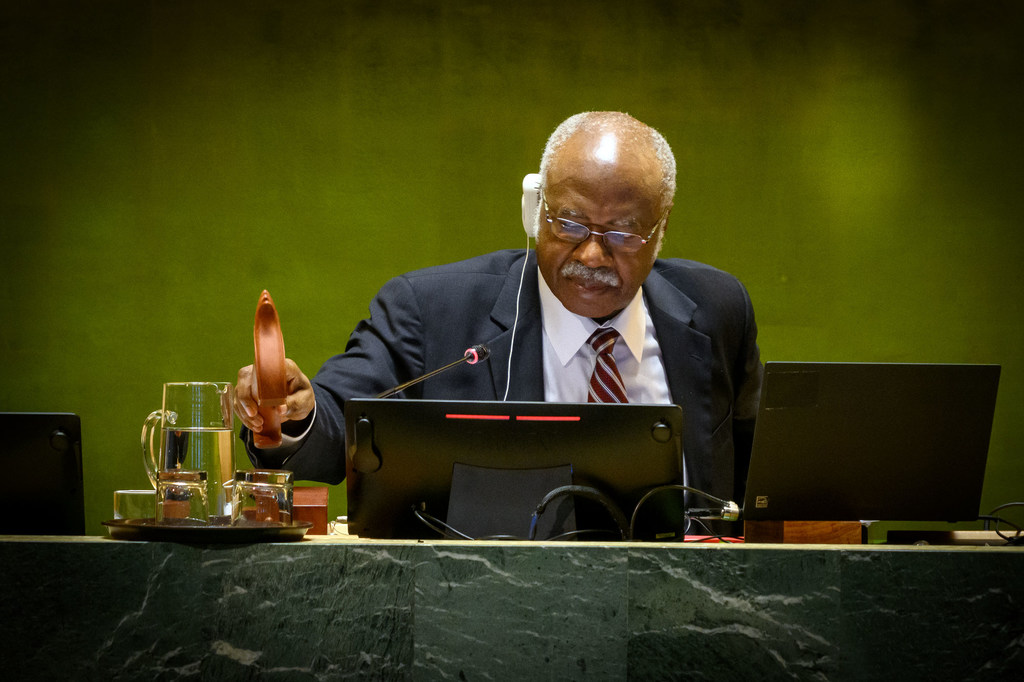
Yang, a former prime minister of Cameroon, had taken over as president of the General Assembly’s 79th session earlier that month. In his opening agenda, he emphasized international peace and security, sustainable development, human rights and reform of the global system.
Those priorities overlapped with many of the themes Shehbaz was taking to the UN.
Pakistan was pushing particularly hard on Gaza and Kashmir, while also raising terrorism, Afghanistan, climate vulnerability, debt pressures and the difficulties developing nations face in financing the Sustainable Development Goals.
The Security Council term would give Islamabad a larger platform to pursue some of those positions.
But it would also bring greater responsibility.
Unlike the General Assembly, where all UN members have a vote, the 15-member Security Council can adopt legally binding decisions and authorize sanctions and peace operations. Five permanent members — the United States, China, Russia, Britain and France — retain veto power.
Pakistan would join the council as one of its ten elected members.
It would be the eighth time Pakistan had served on the body, giving Islamabad significant institutional experience when its new term began.
That history is particularly relevant because Pakistan has long portrayed multilateral diplomacy as an important component of its foreign policy.
The country has also been a major contributor to United Nations peacekeeping operations, providing military and police personnel to missions around the world over several decades.
For Shehbaz, the challenge was to translate that history into influence during a period when the Security Council itself was struggling to respond collectively to major conflicts.
Gaza offered perhaps the clearest example.
Pakistan had strongly supported Palestinian statehood and demanded an immediate ceasefire, while repeated divisions among permanent Security Council members had demonstrated how veto politics could constrain UN action.
Kashmir presented an even more complicated diplomatic challenge.
Islamabad continues to argue that the dispute should be resolved in accordance with relevant UN Security Council resolutions and the wishes of Kashmiris. India rejects third-party intervention and maintains that Jammu and Kashmir is an integral part of the country.
Pakistan’s Security Council membership would not by itself alter either dispute.
But it would give Islamabad a more prominent diplomatic platform from which to raise international security issues and participate directly in negotiations on the council’s agenda.
The timing also mattered for the broader Global South.
Pakistan has repeatedly argued that developing nations deserve greater representation in international institutions and that the global financial and political architecture does not adequately reflect contemporary realities.
Yang himself had made reform and revitalization of the UN system part of his presidency’s agenda.
That created common ground around the principle of stronger multilateral institutions, even where individual governments may differ over how reform should occur.
For Pakistan, the significance of Shehbaz’s UNGA diplomacy therefore extended beyond the speeches and bilateral meetings taking place in New York.
The country was preparing for a transition from advocating its positions before the United Nations to helping shape decisions inside its most important security body.
The election victory had already delivered Pakistan the seat.
The harder test would begin in January — when Islamabad would have to show what it intended to do with it.