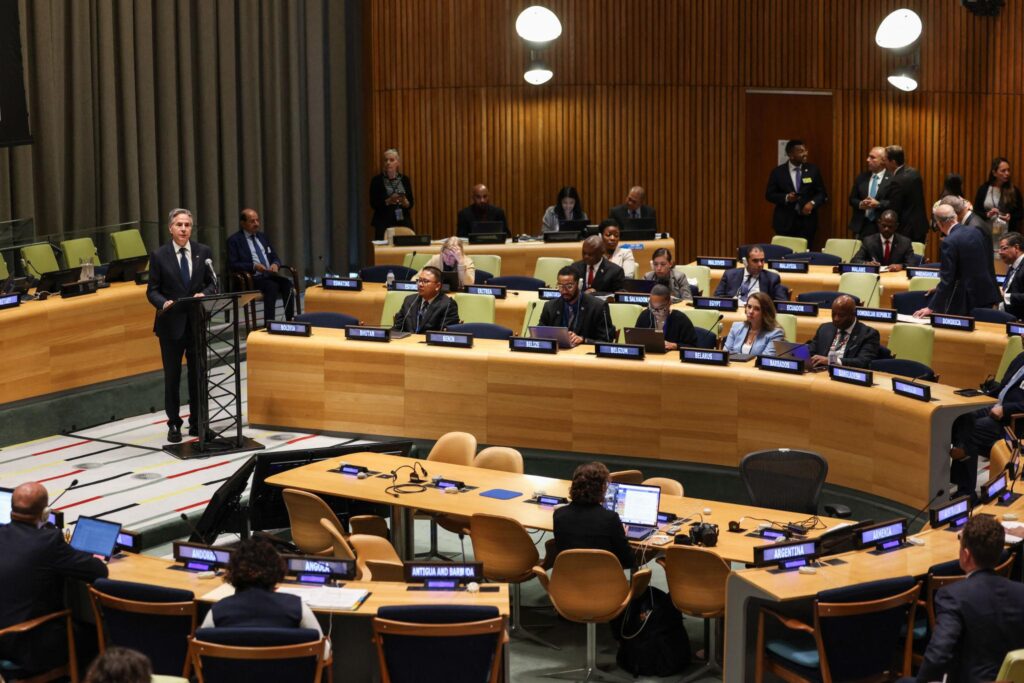
Pakistan’s prime minister attended the UN General Assembly’s first high-level meeting dedicated to the existential threat of sea-level rise, placing one of the world’s most climate-vulnerable countries inside a growing global debate over disappearing coastlines, displacement and the cost of adaptation.
By Saqib S. Qureshi
Senior Correspondent, USA | A1 TV Pakistan
UNITED NATIONS, NEW YORK — September 25, 2024 — Prime Minister Shehbaz Sharif joined world leaders at the United Nations on Wednesday for a landmark high-level meeting focused on the accelerating threat of rising sea levels, as climate change increasingly puts coastal communities, infrastructure and even the territorial future of some nations at risk.
The meeting was part of the 79th session of the United Nations General Assembly, but it was separate from Shehbaz’s main UNGA address, which he delivered two days later on September 27.
Pakistan’s Foreign Ministry confirmed that Shehbaz attended the “High-Level Meeting on Existential Threat posed by Sea-level Rise” on September 25. His participation had also been announced as part of his official UNGA programme before the New York visit.
The event carried particular significance because it was the General Assembly’s first high-level plenary meeting devoted specifically to the dangers posed by rising seas.
For Pakistan, participation placed the country alongside nations confronting different manifestations of the same climate crisis.
Small island states face the most extreme scenario: rising oceans threaten not only homes and infrastructure but potentially the habitability of parts of their national territory.
Pakistan’s exposure is different.
Its climate vulnerabilities include extreme heat, floods, glacial changes and risks affecting its coastline and major population centers. The devastating floods of 2022 had already demonstrated how quickly a climate-related disaster could become an economic and humanitarian emergency on a national scale.
That experience has made climate diplomacy an increasingly important part of Pakistan’s international agenda.
But it is important to distinguish that wider Pakistani position from what is verified about Shehbaz’s participation in this particular meeting.
The official Pakistani account reviewed by A1 TV confirms his attendance at the sea-level session, but does not provide a detailed separate transcript attributing specific remarks to him at that event. A1 TV is therefore not attributing broader statements from his other UN appearances to this meeting.
The wider UN discussion itself carried a stark warning.
The September 25 meeting brought leaders together to confront the consequences of rising seas for communities, economies and national territories, particularly in vulnerable coastal and island states. The process was also intended to help build momentum toward an ambitious declaration on sea-level rise in 2026.
For developing countries, the debate inevitably leads to another question: who will pay for adaptation?
Protecting vulnerable coastlines can require enormous long-term investment — from stronger infrastructure and coastal defenses to resilient water systems, disaster planning and, in the most threatened locations, relocation.
Many of the countries facing those costs contributed relatively little to the historical greenhouse-gas emissions driving global warming.
That tension between climate vulnerability and financial capacity has become one of the defining disputes in international climate diplomacy.
Pakistan has repeatedly positioned itself within that debate as a developing country that has suffered severe climate damage while carrying substantial economic and development pressures.
Shehbaz’s presence at the September 25 meeting therefore mattered even without treating it as another major standalone speech.
It placed Pakistan inside a UN process dealing with a threat that will unfold over decades rather than disappear after a single disaster.
And it formed one part of a much broader UNGA schedule.
During the same high-level week, Shehbaz participated separately in the SDG Moment 2024, where Pakistan’s Foreign Ministry says he called for support to help developing nations escape debt traps worsened by climate disasters and an unfair global financial system. He also addressed the UN Security Council’s “Leadership for Peace” debate and delivered Pakistan’s main General Assembly address on September 27.
Those were different platforms with different statements — and should be reported separately.
The sea-level meeting was significant on its own.
It brought the international community face-to-face with a climate threat that, unlike a storm or flood, develops gradually but can permanently alter where people are able to live.
For Pakistan, simply having a seat in that conversation carried a clear message:
climate change was no longer only an environmental issue on the sidelines of diplomacy — it had become a question of economic security, human survival and the future geography of nations.