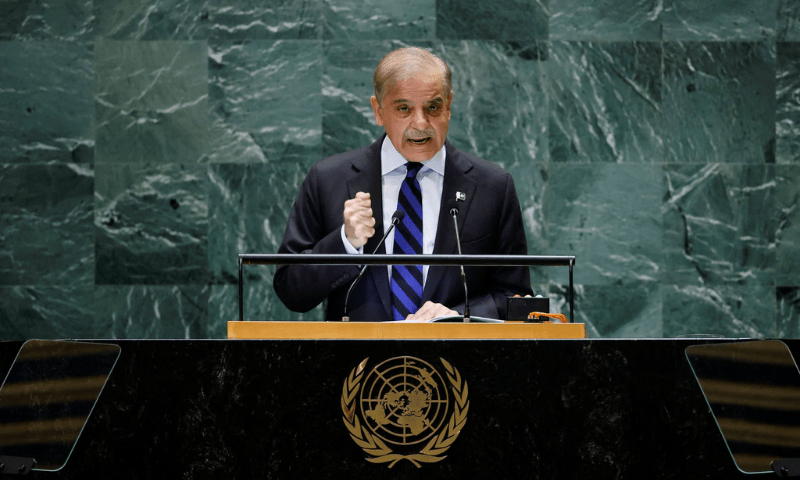
Pakistan’s prime minister told a high-level UN Security Council debate that the international community must move beyond condemnation, calling for sanctions against Israel, including an arms and trade embargo, as wars in Gaza, Ukraine and elsewhere deepen divisions in the global order.
By Saqib S. Qureshi
Senior Correspondent, USA | A1 TV Pakistan
UNITED NATIONS, NEW YORK — September 25, 2024 — Prime Minister Shehbaz Sharif called for sanctions against Israel, including an arms and trade embargo, as he delivered a forceful intervention at the United Nations Security Council amid mounting frustration over the international community’s inability to end the war in Gaza.
Speaking at the council’s high-level open debate on “Leadership for Peace,” Shehbaz argued that the world was facing an increasingly dangerous combination of wars, great-power rivalry and growing poverty — pressures he said were threatening the foundations of international order.
Pakistan’s Foreign Ministry confirmed that Shehbaz participated in the debate on September 25 during his UNGA visit. The official UN record also lists him as a speaker at the Security Council meeting that day.
But Gaza produced his strongest message.
Shehbaz argued that Israel must be held accountable and called for sanctions over the war, including an arms and trade embargo — moving Pakistan’s position beyond demands for a ceasefire toward punitive international measures.
The demand came nearly a year after the October 7 attacks and the start of Israel’s military campaign in Gaza, which had produced enormous civilian casualties, displacement and destruction.
Pakistan has consistently backed an immediate ceasefire and an independent Palestinian state based on pre-1967 borders, with East Jerusalem as its capital.
But Shehbaz’s Security Council intervention raised a more difficult question: what should happen when diplomatic appeals fail to stop a war?
His answer was that international law required enforcement.
The prime minister argued that the Security Council could no longer remain a passive observer while conflicts continued, warning that selective application of international rules damaged the credibility of the global system.
That criticism went to the heart of a crisis confronting the United Nations.
The Security Council has authority to impose sanctions and other binding measures, but its five permanent members — the United States, China, Russia, Britain and France — hold veto power. Deep divisions among them have repeatedly constrained collective action on some of the world’s biggest conflicts.
Gaza was not the only war Shehbaz raised.
He pointed to Ukraine and argued that the conflict should be resolved peacefully rather than allowed to continue escalating. Pakistan had attempted to maintain a carefully balanced position on the war while emphasizing dialogue and diplomacy.
He also brought Kashmir into the discussion, calling it another long-running dispute requiring international attention.
For Islamabad, the connection between Palestine and Kashmir is central to its argument at the UN: disputes involving self-determination cannot be allowed to remain unresolved indefinitely simply because major powers are unwilling or unable to enforce existing international commitments.
India rejects Pakistan’s position on Kashmir and maintains that Jammu and Kashmir is an integral part of the country.
Shehbaz also raised the threat posed by terrorism, including groups operating in and around Afghanistan, placing Pakistan’s own security concerns within his broader argument about international peace.
The timing of the address was particularly significant.
Pakistan had already been elected to the Security Council for a two-year term beginning in January 2025.
That meant Shehbaz was addressing a chamber Pakistan would soon join as one of its ten elected members.
The country would not have the veto enjoyed by the five permanent powers, but it would gain a direct role in negotiations, votes and debates involving international security.
That gives Pakistan an opportunity — and a test.
It can continue pressing for stronger action on Palestine and other conflicts, but Security Council membership also requires engagement on crises far beyond Pakistan’s immediate foreign-policy priorities.
Shehbaz’s September intervention offered an early indication of the position Islamabad intended to carry into that term: international law must apply consistently, civilian suffering cannot become politically acceptable, and the Security Council must become more effective at preventing and ending wars.
Pakistan’s demand for an Israeli arms and trade embargo was unlikely, by itself, to overcome the political divisions surrounding Gaza.
But that was also the point of Shehbaz’s argument.
The problem, he suggested, was no longer a shortage of statements condemning war.
It was the gap between those statements and meaningful international action.
With Pakistan preparing to take its own seat at the Security Council table, Islamabad would soon have an opportunity to push that argument from inside the chamber.
And that would test whether Pakistan could turn the forceful language heard in New York into sustained diplomatic pressure when it became a member of the council itself.