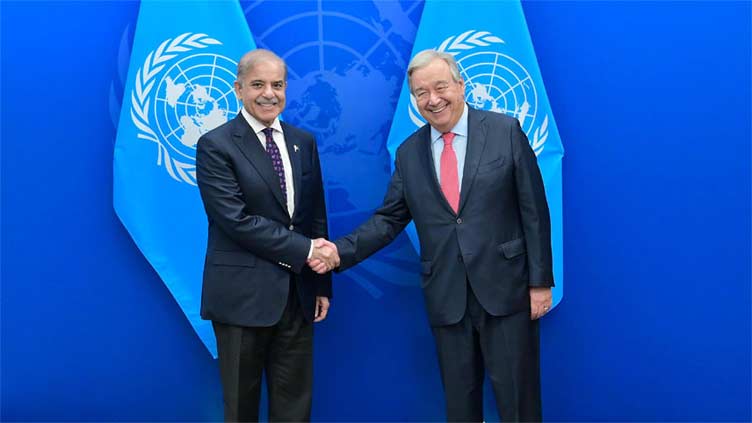
Pakistan’s prime minister used talks with the UN chief in New York to push for a Gaza ceasefire, renewed international attention on Kashmir and stronger action against Islamophobia, while positioning Islamabad for its return to the Security Council.
By Saqib S. Qureshi
Senior Correspondent, USA | A1 TV Pakistan
UNITED NATIONS, NEW YORK — September 24, 2024 — Prime Minister Shehbaz Sharif met UN Secretary-General António Guterres in New York as Pakistan sought to turn its concerns over Gaza, Kashmir and regional instability into a broader diplomatic agenda ahead of its two-year term on the United Nations Security Council.
The UN confirmed that the two leaders met on September 24 during the opening day of the General Assembly’s high-level debate. Guterres’ official schedule placed the meeting at 3:40 p.m.
The United Nations’ own readout was brief but significant: Guterres thanked Pakistan for its support of the UN, including its longstanding contribution to peacekeeping, while the two leaders exchanged views on Afghanistan, the Middle East and other regional developments.
Pakistan’s account provided considerably more detail — and showed that Shehbaz used the encounter to press some of Islamabad’s most important foreign-policy priorities.
At the center was Gaza.
Shehbaz condemned Israel’s military campaign and called for an immediate and unconditional ceasefire, while reiterating Pakistan’s support for an independent and sovereign Palestinian state. He also urged greater international accountability over the conduct of the war.
The meeting came as the conflict was threatening to expand further across the Middle East, making Gaza one of the dominant issues confronting leaders gathered for UNGA 79.
For Pakistan, however, Shehbaz wanted another unresolved conflict kept firmly on the UN agenda: Jammu and Kashmir.
He briefed Guterres on Pakistan’s concerns over Indian policies in the disputed territory and called on the secretary-general to use his diplomatic “good offices” to advance implementation of relevant UN Security Council resolutions and the right of Kashmiris to self-determination.
India rejects Pakistan’s characterization of the dispute and maintains that Jammu and Kashmir is an integral part of India.
The exchange highlighted a longstanding challenge for Islamabad. Pakistan has repeatedly sought international involvement on Kashmir, while New Delhi has resisted third-party mediation and favors handling outstanding issues bilaterally.
Shehbaz also raised Islamophobia and discrimination against Muslims, another issue Pakistan has increasingly pushed through multilateral institutions.
But the meeting had another important dimension.
Pakistan was preparing to return to the UN Security Council as an elected non-permanent member for 2025-2026.
Shehbaz told Guterres that Pakistan intended to contribute actively to international peace and security during that term.
That gives the meeting a significance extending beyond a routine UNGA bilateral.
Once inside the Security Council, Pakistan would gain a direct seat at the table where wars, sanctions, peacekeeping missions and some of the world’s most serious security crises are debated — even though the five permanent members retain veto power.
It also means Islamabad’s positions would face greater scrutiny.
Pakistan would be expected not only to advocate on Gaza and Kashmir, but to engage with conflicts and security crises far beyond South Asia.
Afghanistan is likely to remain particularly important.
The UN’s readout specifically confirmed that Afghanistan was discussed by Guterres and Shehbaz.
Pakistan has repeatedly warned about attacks by the Tehrik-e-Taliban Pakistan and other militants it says operate from Afghan territory, while also maintaining that a peaceful and stable Afghanistan is essential for regional security.
That combination — supporting Afghan stability while confronting cross-border militancy — has become one of Islamabad’s most difficult foreign-policy challenges.
There was also a more positive element to the talks.
Guterres praised Pakistan’s contribution to UN peacekeeping, an area where Pakistani military and police personnel have served for decades.
For Islamabad, that record supports its argument that Pakistan is not merely seeking influence within the UN system but has contributed personnel directly to its peace and security operations.
Shehbaz also welcomed Guterres’ Summit of the Future initiative and expressed hope that its outcomes would help developing nations close financing gaps for the Sustainable Development Goals and climate commitments.
That brought economics and climate into the diplomatic conversation.
Pakistan was still dealing with the consequences of the catastrophic 2022 floods while simultaneously navigating debt pressures and an IMF-backed economic stabilization program.
The message running through Shehbaz’s wider UNGA visit was that security, development and climate vulnerability could no longer be treated as separate problems.
His meeting with Guterres brought those strands together.
Pakistan wanted the UN to act more forcefully on Gaza, keep Kashmir internationally visible, address instability linked to Afghanistan and give developing nations a stronger voice in a global system Islamabad argues is increasingly unequal.
And with Pakistan preparing to enter the Security Council only months later, Shehbaz was positioning the country not simply as a state asking the UN to act.
Pakistan was preparing to become part of the body expected to make some of those decisions itself.