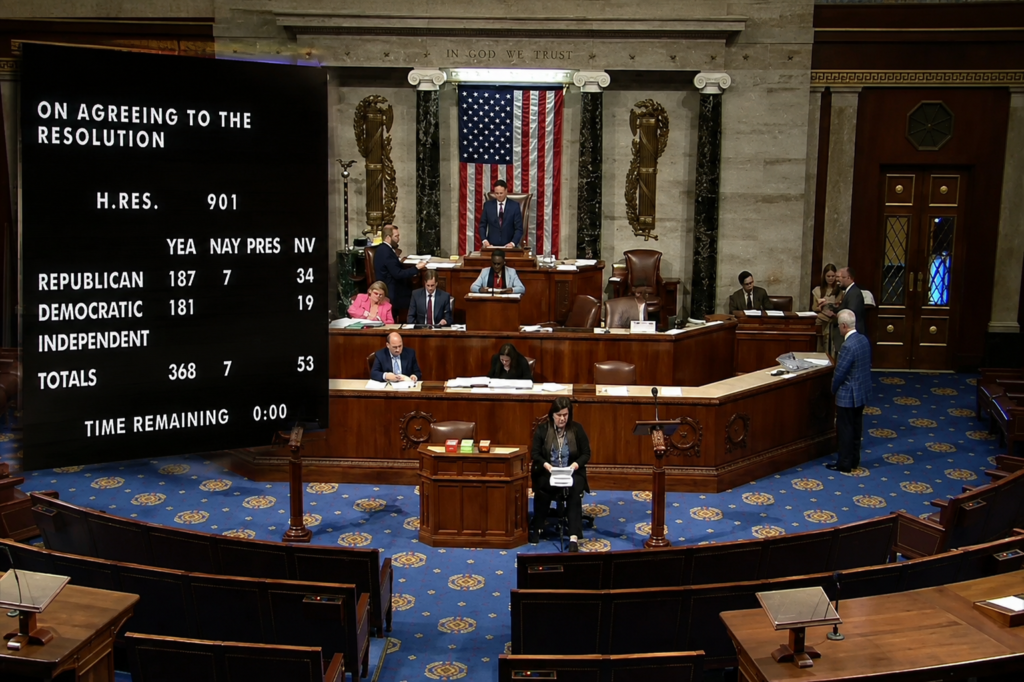
The extraordinary bipartisan vote put Pakistan’s February election and democratic record formally on the agenda of the U.S. Congress, even as Washington and Islamabad continued cooperation on security and economic issues. Pakistan rejected the move as an unwelcome intervention in its domestic affairs.
By Saqib S. Qureshi
Senior Correspondent, USA | A1 TV Pakistan
WASHINGTON — June 25, 2024 — The U.S. House of Representatives overwhelmingly approved a resolution Tuesday expressing support for democracy and human rights in Pakistan and calling for a full and independent investigation into claims of interference or irregularities in the country’s February election.
The margin was striking: 368 lawmakers voted in favor and only seven opposed H.Res.901.
Official House voting records show the measure drew support from 187 Republicans and 181 Democrats, giving the Pakistan resolution an unusually broad bipartisan majority. All seven opposing votes came from Republicans.
For Washington’s relationship with Islamabad, the vote carried a message difficult to ignore.
Months after the Biden administration first raised concerns about Pakistan’s February 8 election, congressional unease over the country’s democratic trajectory had moved from statements, letters and hearings to an overwhelming vote on the House floor.
Congress puts Pakistan democracy on record
The resolution, sponsored by Republican Rep. Rich McCormick of Georgia, was titled “Expressing support for democracy and human rights in Pakistan.”
Importantly, the resolution did not frame Pakistan simply as an adversary. Its text explicitly described the country as an “important and valued partner of the United States.”
But Congress paired that recognition with significant criticism.
The resolution expressed support for democracy in Pakistan, including free and fair elections, and called on the U.S. president to work with Pakistan to uphold democracy, human rights and the rule of law.
It also called for a full and independent investigation into claims of interference or irregularities surrounding Pakistan’s February 2024 election.
That made the vote directly relevant to the political controversy Washington had been following since election day.
From State Department concern to Capitol Hill action
The House vote did not emerge in isolation.
Washington’s scrutiny of Pakistan had been building for months.
After the February election, the Biden administration raised concerns about restrictions and allegations of electoral interference and called for credible claims to be investigated.
Then, on March 20, Assistant Secretary of State Donald Lu appeared before Congress at a hearing devoted specifically to Pakistan after the elections, democracy and the future of U.S.-Pakistan relations.
Lu was questioned about electoral irregularities, political freedoms, Imran Khan and allegations that the United States had played a role in Khan’s removal from office — allegations Washington denied.
The congressional process surrounding H.Res.901 was developing simultaneously. The House Foreign Affairs Committee approved the amended resolution in March by 50-0 before it eventually reached the full House.
By June 25, the result was unmistakable.
Pakistan democracy concerns had attracted support across the American political divide.
But this was not a break in U.S.-Pakistan relations
The scale of the vote was politically significant, but H.Res.901 was a House resolution — not a new sanctions law or an order severing U.S. relations with Pakistan.
That distinction matters.
The Biden administration was continuing to engage the Pakistani government.
President Joe Biden had already reached out to Prime Minister Shehbaz Sharif in March, while American and Pakistani officials held a Counterterrorism Dialogue in Washington in May focusing on threats including TTP and ISIS-K.
So by June, two tracks were operating at the same time.
Congress was increasing pressure over democracy and elections, while the executive branch continued practical engagement with Islamabad.
That increasingly became the defining Washington dynamic toward Pakistan in 2024.
Islamabad pushes back
Pakistan reacted sharply.
Its Foreign Ministry said the resolution reflected an incomplete understanding of Pakistan’s political situation and electoral process and argued that its timing did not align with what Islamabad described as the positive dynamics of bilateral relations.
Pakistan subsequently hardened that criticism.
The Foreign Ministry described the resolution as “unsolicited interference” in Pakistan’s domestic affairs and said bilateral relations should be based on mutual respect and sovereign equality.
Defence Minister Khawaja Asif was even more direct, arguing that the U.S. House had no right to interfere in Pakistan’s internal affairs.
The response demonstrated why the congressional vote posed a diplomatic challenge.
Islamabad wanted stronger relations with Washington, including economic and security cooperation.
But it was unwilling to accept congressional judgments about Pakistan’s domestic political system without pushing back publicly.
What the 368-7 vote actually meant
The resolution did not force the Biden administration to impose sanctions or fundamentally change Pakistan policy.
But politically, the margin mattered.
A vote of 368-7 showed that concern about democracy and human rights in Pakistan was not confined to a small group of lawmakers or one American political party.
Republicans and Democrats overwhelmingly supported the same resolution.
That gave Pakistan’s domestic political situation a level of congressional visibility that Islamabad could not easily dismiss as purely partisan politics.
It also demonstrated how dramatically the Washington conversation about Pakistan had changed.
For much of the post-9/11 era, congressional debate about Pakistan centered on Afghanistan, terrorism, military assistance and nuclear security.
In 2024, another subject had moved prominently onto Capitol Hill:
Pakistan’s own democracy.
And while H.Res.901 did not rewrite U.S. policy overnight, the 368-7 vote sent Islamabad perhaps the clearest congressional message of the year:
Washington wanted the strategic relationship to continue — but a large bipartisan majority in Congress was no longer willing to keep Pakistan’s electoral and democratic controversies outside that relationship.