By Saqib S. Qureshi
Senior Correspondent | A1 TV Pakistan
At the United Nations, Pakistan’s then-caretaker prime minister Anwaar-ul-Haq Kakar delivered a sweeping critique of an increasingly divided international order, warning that renewed great-power rivalry risks pushing the world toward another Cold War while conflicts, climate disasters, debt and terrorism place developing nations under extraordinary pressure.
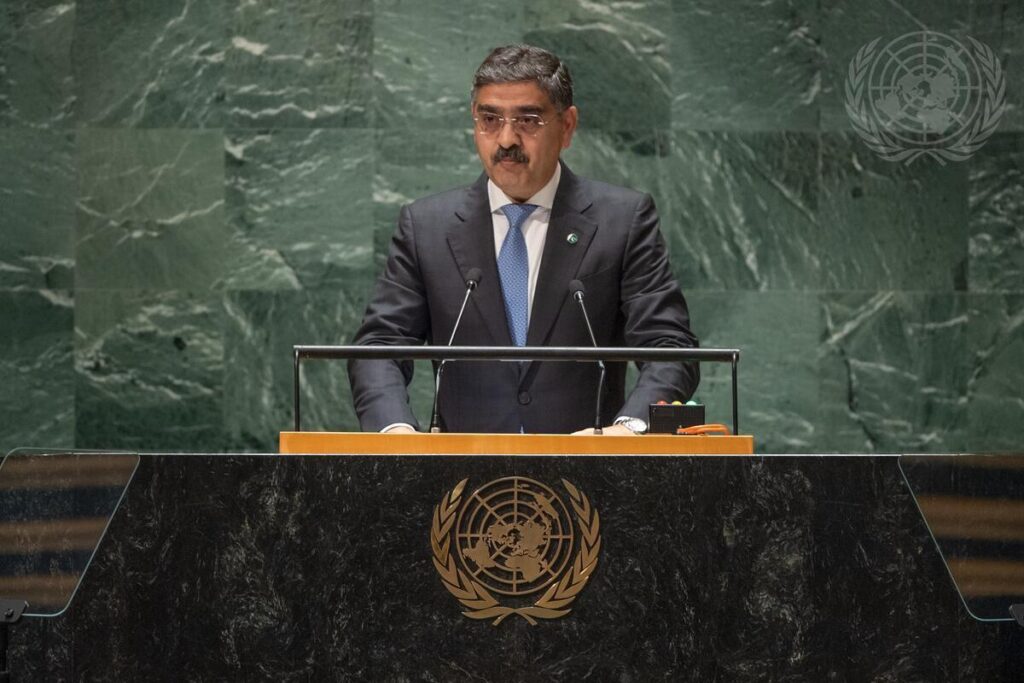
NEW YORK — Standing before the United Nations General Assembly at a moment of intensifying geopolitical rivalry, Pakistan’s then-caretaker Prime Minister Anwaar-ul-Haq Kakar delivered a message that went far beyond Pakistan’s borders: the international system is becoming more divided precisely when humanity’s biggest crises require countries to work together.
“The world cannot afford Cold War 2.0,” Kakar told the 78th session of the UN General Assembly on September 22, 2023, as he warned of escalating tensions among major powers and the emergence of new and old political and military blocs.
His speech brought together several pillars of Pakistan’s foreign-policy agenda — Kashmir, Afghanistan, climate justice, economic reform, terrorism, Palestine, Islamophobia and relations among the world’s major powers — into a broader argument about what Islamabad sees as the failures of the international order.
A Warning Against a New Global Divide
Kakar argued that geopolitics was again taking precedence at a time when the world should be concentrating on economic cooperation.
Wars and geopolitical confrontation, he warned, are unfolding alongside challenges that cannot be contained within national borders.
The COVID-19 pandemic, conflicts and climate change had created successive external shocks for developing economies, reversing years of progress against poverty and hunger.
For Pakistan, the consequences were not theoretical.
Kakar pointed to the catastrophic 2022 floods as evidence of how climate change can become an economic, humanitarian and development crisis simultaneously.
The floods submerged roughly a third of Pakistan, killed around 1,700 people, displaced more than eight million and caused more than $30 billion in economic damage, according to figures cited by Kakar at the UN.
The disaster transformed Pakistan into one of the most prominent international advocates for climate financing and compensation for vulnerable developing economies.
Pakistan Demands Climate Finance
Kakar used the UN platform to press developed countries to fulfil their international climate commitments.
He called for greater climate financing for developing countries, stronger funding for adaptation and effective arrangements to address climate-related loss and damage.
For Islamabad, the argument was fundamentally about responsibility and fairness: countries that have contributed comparatively little to historical global emissions can nevertheless face some of the most devastating consequences of a warming planet.
Kakar also welcomed international commitments exceeding $10.5 billion toward Pakistan’s comprehensive post-flood recovery framework, known as the 4RF Plan, and urged development partners to prioritize the allocation of those funds.
But climate financing was only part of a wider economic challenge.
The Pakistani leader called for implementation of the Sustainable Development Goals stimulus, expansion of concessional lending by multilateral development banks and action to resolve the debt difficulties confronting dozens of developing countries.
Pakistan’s Economic Strategy: From Geopolitics to Geoeconomics
Kakar presented Pakistan as attempting to reposition itself economically despite severe domestic pressures.
His government, he said, was working to stabilize foreign-exchange reserves and the currency, expand domestic revenues and attract substantial domestic and international investment.
“Pakistan’s long-term shift to geoeconomics is well underway,” he said.
Central to that strategy was the China-Pakistan Economic Corridor.
Kakar said the second phase of CPEC had begun, underscoring Islamabad’s intention to place connectivity, investment, infrastructure and regional trade at the center of its long-term foreign economic strategy.
The message was significant: Pakistan wanted to present itself not simply as a country positioned between competing geopolitical blocs, but as a potential economic bridge connecting South Asia, China, Central Asia and the wider region.
Kashmir Returns to the UN Stage
Kakar then turned to one of the most contentious elements of Pakistan’s foreign policy: Jammu and Kashmir.
“Kashmir is the key to peace between Pakistan and India,” he said.
He accused India of maintaining approximately 900,000 troops in what Pakistan describes as illegally occupied Jammu and Kashmir and alleged widespread restrictions, detentions, extrajudicial killings and collective punishment following New Delhi’s August 5, 2019 decision to revoke the region’s special constitutional status.
These were Pakistan’s allegations against India, and India has consistently rejected Islamabad’s characterization of Kashmir and maintains that Jammu and Kashmir is an integral part of India.
Kakar nevertheless urged the international community to play a greater role.
He called on the UN Security Council to secure implementation of its Kashmir resolutions and urged major powers to persuade India to accept Pakistan’s proposal for mutual restraint involving strategic and conventional weapons.
His remarks reinforced Islamabad’s long-standing effort to keep Kashmir internationalized despite New Delhi’s insistence that outside intervention is inappropriate.
Afghanistan: Peace — but No Sanctuary for Militants
Kakar’s message toward neighboring Afghanistan combined support with a direct security warning.
Peace in Afghanistan, he said, remained a “strategic imperative for Pakistan.”
He called for continued humanitarian assistance, particularly for vulnerable Afghan women and girls, economic revival and implementation of regional connectivity projects linking Afghanistan with Central Asia.
But he also identified terrorism emanating from Afghan territory as one of Pakistan’s most serious security concerns.
Kakar condemned cross-border attacks against Pakistan by the Tehrik-e-Taliban Pakistan, Da’esh and other militant organizations operating from Afghanistan.
Pakistan, he said, had sought Kabul’s cooperation in preventing such attacks while taking its own measures against terrorism.
The issue has become one of the most difficult elements of relations between Islamabad and Afghanistan’s Taliban authorities.
Palestine, Syria and a Changing Middle East
Kakar also addressed the rapidly changing political landscape of the Middle East.
He welcomed progress toward ending conflicts in Syria and Yemen and praised the normalization process between Saudi Arabia and Iran.
But he described Palestine as an unresolved tragedy, pointing to Israeli military raids, air strikes, settlement expansion and Palestinian evictions.
His remarks placed Pakistan firmly within its traditional diplomatic position supporting Palestinian rights and opposition to Israeli occupation.
Terrorism Cannot Be Fought Selectively
Another central theme of Kakar’s address was his rejection of what Pakistan considers selective approaches to terrorism.
He argued that terrorism must be confronted without discrimination while its underlying causes — including injustice, poverty and foreign occupation — must also be addressed.
Pakistan’s position, as articulated by Kakar, sought to distinguish internationally recognized struggles for self-determination from terrorism while condemning attacks on civilians and extremist violence.
It was also connected to Islamabad’s wider argument that the international community should confront not only non-State militant organizations but extremist ideological movements and what Pakistan describes as State terrorism.
Islamophobia Becomes a Global Diplomatic Issue
Kakar devoted part of his address to the rise of Islamophobia.
He argued that anti-Muslim prejudice had intensified dramatically following the September 11 attacks, manifesting itself through negative profiling of Muslims and attacks against Islamic religious symbols and institutions.
Recent public burnings of the Quran in Europe were among the incidents Pakistan had strongly condemned.
Pakistan had already played a leading diplomatic role alongside the Organization of Islamic Cooperation in pushing the United Nations to formally recognize March 15 as the International Day to Combat Islamophobia.
Kakar’s message was that religious hatred could no longer be treated merely as a domestic social problem. Islamabad wanted it recognized as an international human-rights and security concern.
A Speech About Pakistan — and the International System
The significance of Kakar’s UN address was ultimately broader than any single dispute.
Pakistan presented itself as a developing country caught at the intersection of several of the defining pressures of the modern international system: climate vulnerability, debt and economic instability, terrorism, unresolved regional conflicts and intensifying competition among major powers.
Islamabad’s argument was that these crises cannot be solved by a world divided into rival geopolitical camps.
The speech therefore combined Pakistan’s immediate national interests with a challenge to the structure of international politics itself.
Kakar called for cooperation instead of bloc confrontation, climate justice instead of unfulfilled promises, economic connectivity instead of geopolitical isolation and multilateral diplomacy instead of an uncontrolled return to great-power rivalry.
For Pakistan, Kashmir remained central to peace in South Asia. Stability in Afghanistan remained essential to national security. Climate finance remained a question of justice rather than charity. And economic connectivity — particularly through CPEC — remained central to its vision of moving from geopolitics toward geoeconomics.
From the UN podium, however, Kakar’s largest warning was directed at everyone.
A world already confronting war, climate disasters, terrorism, poverty and economic instability, Pakistan argued, cannot afford to divide itself once again into hostile camps.
The choice presented by Islamabad was stark: deeper global cooperation — or the emergence of a “Cold War 2.0” at precisely the moment humanity can least afford one.