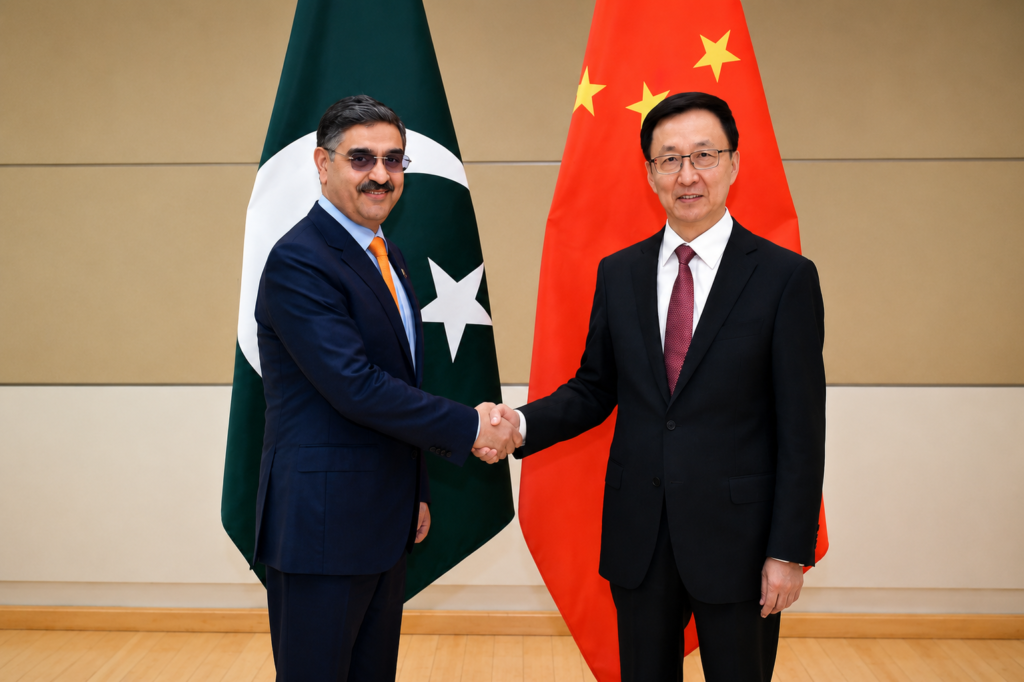
Pakistan and China pledged to deepen their “All-Weather Strategic Cooperative Partnership” as their leaders discussed CPEC, economic and financial cooperation and Kashmir on the sidelines of the UN General Assembly in New York.
By Saqib S. Qureshi
Senior Correspondent | A1 TV Pakistan
NEW YORK, Sept. 21, 2023 — Pakistan’s caretaker Prime Minister Anwaar-ul-Haq Kakar and Chinese Vice President Han Zheng reaffirmed the strength of the Pakistan-China strategic partnership during high-level talks in New York, placing the China-Pakistan Economic Corridor and deeper economic cooperation at the center of their discussions.
The meeting took place on the sidelines of the 78th session of the United Nations General Assembly and came as Pakistan was attempting to stabilize its economy, attract foreign investment and advance the next phase of CPEC.
According to Pakistan’s official government account, the two leaders discussed the broader bilateral relationship, including CPEC as well as economic and financial cooperation between Islamabad and Beijing. The government described the talks as reflecting the traditional warmth associated with the countries’ “All-Weather Strategic Cooperative Partnership.”
For Pakistan, the meeting was significant beyond diplomatic symbolism. China was already deeply embedded in Pakistan’s infrastructure and development strategy through CPEC, while Islamabad was increasingly presenting regional connectivity and investment as part of a wider shift from geopolitics toward geoeconomics.
CPEC Remains at the Heart of Pakistan-China Ties
Kakar and Han expressed their commitment to continue working toward CPEC’s shared objectives, reinforcing the corridor’s position as the flagship economic component of the bilateral relationship. Pakistan’s official account of Kakar’s UNGA engagements subsequently highlighted that commitment.
CPEC, launched as a major component of China’s Belt and Road Initiative, brought large-scale investment into Pakistan in energy, transport and infrastructure.
By 2023, however, Islamabad was increasingly looking beyond the corridor’s initial infrastructure-heavy phase toward industrialization, investment, agriculture, technology and broader economic cooperation.
That transition was especially important for a Pakistan struggling with foreign-exchange shortages and seeking sustainable sources of investment rather than relying principally on external borrowing.
Kakar Thanks Beijing for Support to Pakistan
During the meeting, Kakar reiterated Pakistan’s support for China on issues Beijing regards as central to its national interests.
He also thanked China for what Pakistan’s government described as Beijing’s unwavering support for Pakistan’s territorial integrity, sovereignty and socioeconomic development.
The exchange illustrated the political foundation beneath the economic partnership.
For decades, successive Pakistani governments — despite significant changes in domestic politics — have maintained close strategic relations with Beijing.
Han told Kakar that the Pakistan-China friendship was unique and had endured changing circumstances because of the deep ties between the peoples of the two countries.
Kashmir Enters the Discussion
Kashmir was also raised during the meeting.
Kakar specifically welcomed China’s opposition to holding a G20 meeting in the disputed Jammu and Kashmir region, describing Beijing’s position as consistent with international law and United Nations resolutions.
India hosted a G20 tourism working group meeting in Srinagar in May 2023. China did not attend that meeting.
Pakistan opposed India’s decision to hold the event in the territory, while New Delhi maintains that Jammu and Kashmir is an integral part of India.
Kakar’s decision to raise the matter with Han showed how closely Pakistan’s strategic partnership with China intersects with Islamabad’s regional diplomacy.
Economic Cooperation at a Critical Moment
The economic dimension of the meeting carried particular weight because of the circumstances Pakistan faced in 2023.
Islamabad was operating under a $3 billion IMF Stand-By Arrangement and trying to rebuild foreign-exchange reserves while restoring investor confidence.
Against that backdrop, relations with China were important not only in strategic terms but also in Pakistan’s efforts to expand investment and economic activity.
Kakar was simultaneously using his New York visit to court international investors and financial institutions.
His UNGA schedule included engagements with the IMF leadership, international corporations and the U.S.-Pakistan Business Council, illustrating a broader effort to present Pakistan as open to investment from multiple economic partners rather than tied exclusively to one bloc.
Pakistan Signals It Does Not Want ‘Camp Politics’
The Kakar-Han meeting also took place against the wider backdrop of intensifying competition between China and the United States.
That geopolitical environment posed an obvious challenge for Pakistan.
China was one of Pakistan’s closest strategic partners, while the United States remained an important diplomatic, economic and trade relationship.
Speaking separately in New York on September 21, Kakar said Pakistan did not want to become part of “camp politics” and wanted to maintain good relations with both Washington and Beijing.
That position was closely connected to the message Pakistan was carrying throughout UNGA week: economic development required stability and international cooperation rather than another division of the world into competing blocs.
China’s Global Development Initiative
The bilateral meeting was not Kakar’s only China-related engagement during the UNGA visit.
Two days earlier, on September 19, he participated in a high-level meeting on cooperation under China’s Global Development Initiative, where Han Zheng also delivered opening remarks.
Kakar backed the initiative and described both the Belt and Road Initiative and CPEC as important vehicles for advancing the Sustainable Development Goals.
He identified food production, infrastructure investment, industrialization, resilient healthcare and closing the digital divide as areas requiring greater international action.
Together, the GDI event and the subsequent Kakar-Han bilateral meeting demonstrated that Pakistan was attempting to connect its relationship with China to a broader development strategy rather than treating CPEC solely as an infrastructure program.
Why the Meeting Mattered
The meeting reinforced three important elements of Pakistan’s China policy.
First, CPEC remained the economic centerpiece of the relationship.
Second, Islamabad continued to view Beijing as a major strategic partner willing to support Pakistan on sensitive regional and international issues.
Third, Pakistan was trying to deepen its economic relationship with China without allowing intensifying U.S.-China competition to force Islamabad into an exclusive geopolitical camp.
That balancing act would become increasingly important as competition among major powers intensified.
For Kakar, the New York meeting offered an opportunity to make Pakistan’s position clear: its relationship with China remained strategic and long-term, CPEC remained central to its economic ambitions, and Islamabad wanted that partnership to advance without closing the door on economic and diplomatic engagement with the West.
The talks therefore represented more than another bilateral meeting on the margins of UNGA.
They reflected Pakistan’s attempt to navigate a changing global order while keeping its most consequential strategic partnership firmly intact.