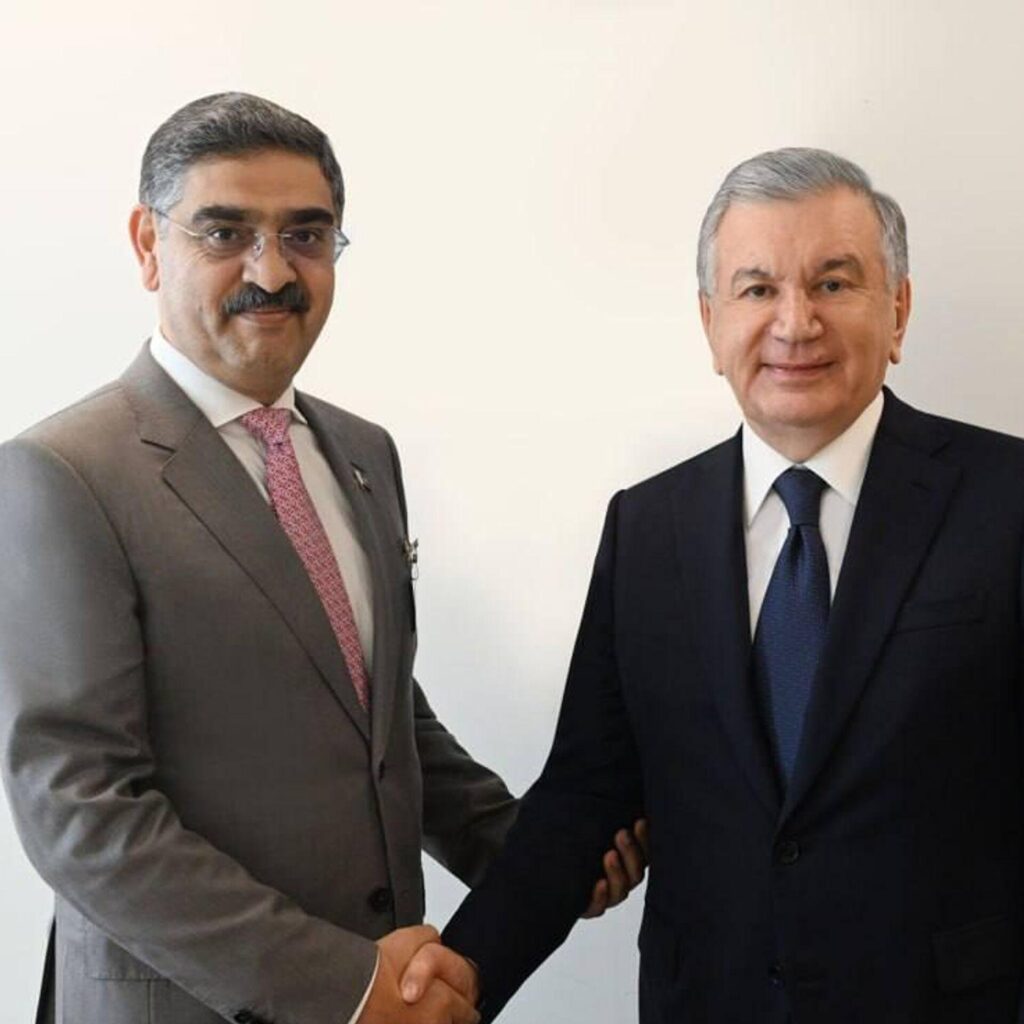
Pakistan and Uzbekistan used a high-level UNGA meeting in New York to advance an ambitious regional connectivity agenda, with trade rising sharply and both sides backing a railway that could link landlocked Central Asia through Afghanistan to Pakistan.
By Saqib S. Qureshi
Senior Correspondent | A1 TV Pakistan
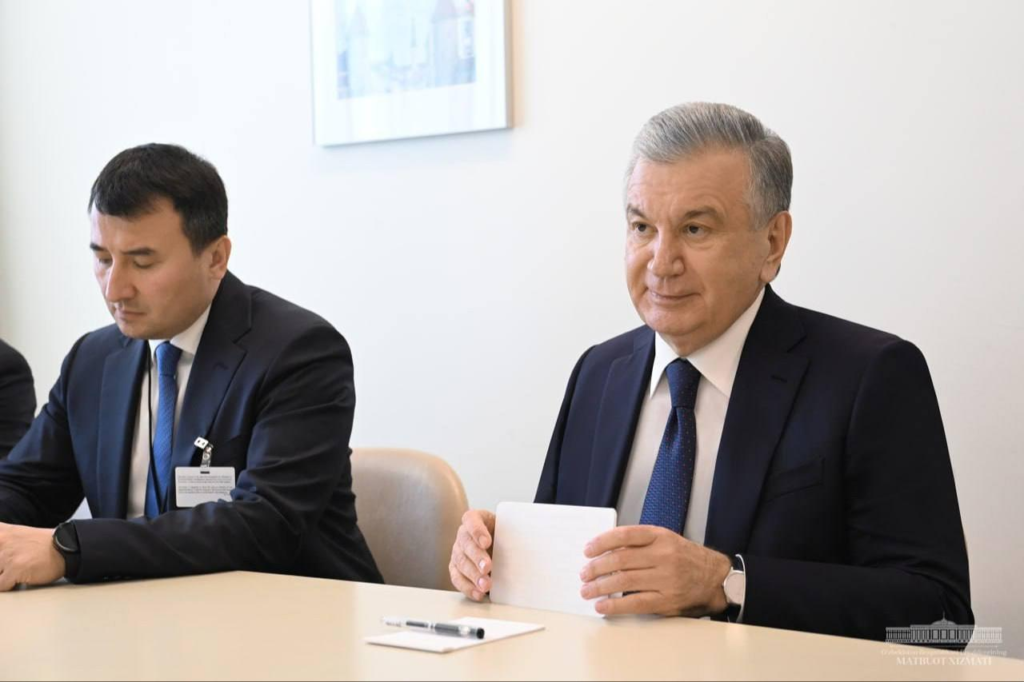
NEW YORK, Sept. 20, 2023 — Pakistan’s caretaker Prime Minister Anwaar-ul-Haq Kakar and Uzbekistan President Shavkat Mirziyoyev held bilateral talks on the sidelines of the 78th United Nations General Assembly on Wednesday, putting trade, investment and an ambitious Trans-Afghan railway project at the center of efforts to deepen their strategic partnership.
The meeting brought together two countries increasingly focused on a common objective: creating stronger economic links between Central and South Asia.
Pakistan’s official account said the leaders discussed expanding cooperation across political, trade, economic, security, defence and connectivity sectors. Kakar emphasized maintaining the momentum that had developed in bilateral relations in preceding years.
But Uzbekistan’s official account provided additional figures showing just how rapidly some elements of the relationship were developing.
According to the Uzbek presidency, bilateral trade had increased 75 percent since the beginning of 2023, cargo transportation had risen 50 percent, and 20 new joint ventures had been established.
Those numbers gave the New York meeting an economic significance extending well beyond diplomatic symbolism.
Trans-Afghan Railway Emerges as Strategic Priority
One of the most consequential subjects was the proposed Uzbekistan-Afghanistan-Pakistan railway, commonly referred to as the Trans-Afghan Railway.
Kakar reaffirmed Pakistan’s commitment to the timely completion of the project, while the Uzbek presidency said both sides emphasized joint efforts to advance its construction.
The railway represents a much larger strategic ambition.
Landlocked Uzbekistan and other Central Asian economies have long sought more efficient access to international markets. A functioning rail corridor through Afghanistan and Pakistan could potentially connect Central Asian trade routes with Pakistan’s transport network and, ultimately, its seaports.
For Pakistan, that could strengthen its ambition to become a regional trade and transit hub rather than remaining primarily an endpoint for regional commerce.
For Uzbekistan, it could provide another route toward maritime trade.
And for Afghanistan, successful regional connectivity could create transit activity and greater economic integration.
Kakar Links Connectivity to Afghan Stability
Kakar made that connection explicitly.
Pakistan’s official account said the prime minister argued that greater regional connectivity, trade and economic integration could have a stabilizing effect on Afghanistan.
That argument was important because Afghanistan represented both the greatest opportunity and the biggest obstacle to the proposed corridor.
Geographically, Afghanistan provides the bridge between Uzbekistan and Pakistan.
Politically and from a security standpoint, however, instability inside Afghanistan has repeatedly complicated large cross-border infrastructure projects.
Kakar and Mirziyoyev therefore also exchanged views on regional security and developments in Afghanistan.
The railway discussion illustrated Islamabad’s broader argument during UNGA week: economic integration itself could become a tool for regional stability.
Pakistan and Uzbekistan Target Bigger Trade
The leaders also focused on removing barriers to bilateral commerce.
Kakar highlighted the Preferential Trade Agreement (PTA) and the Uzbekistan-Pakistan Transit Trade Agreement (UPTTA) as mechanisms capable of increasing trade and transit flows between the two countries.
Mirziyoyev similarly stressed creating favorable conditions for increasing trade under the Preferential Trade Agreement.
The objective was not simply to sell more goods directly between Pakistan and Uzbekistan.
A functioning transit framework could help build a larger commercial corridor connecting Central Asian economies with South Asian markets.
That possibility makes transport infrastructure — highways, railways, border facilities and logistics networks — an increasingly important component of Pakistan-Uzbekistan relations.
Textiles, Pharmaceuticals and Tourism on Investment Agenda
The Uzbek presidency disclosed further detail about the commercial discussions.
The leaders considered potential joint investment projects in textiles, pharmaceuticals, electrical industries and tourism, while also identifying opportunities for greater cooperation between different regions of the two countries.
That diversification matters.
Pakistan-Uzbekistan economic relations were increasingly moving beyond traditional government-to-government diplomacy toward private investment, joint ventures and transport integration.
With 20 new joint ventures reported by Uzbekistan during the year, the relationship was already showing signs of deeper commercial activity.
From Two Countries to Two Regions
Perhaps the most important element of the meeting was its geographic ambition.
Pakistan and Uzbekistan were not discussing connectivity solely as a bilateral project.
Both governments reiterated support for regional economic integration and inter-regional connectivity.
That means connecting two historically separated economic spaces: Central Asia and South Asia.
Pakistan’s location gives it a potentially important role in that vision.
If reliable transport corridors can cross Afghanistan, goods originating in Uzbekistan and elsewhere in Central Asia could move south toward Pakistan, while Pakistani businesses could gain improved overland access to Central Asian markets.
The Trans-Afghan Railway therefore represents more than another infrastructure project.
It is an attempt to redraw the region’s economic geography.
Security Remains the Critical Variable
Yet almost every element of that vision depends on Afghanistan.
The leaders discussed regional security and the situation there because commercial corridors cannot function effectively without predictable security, political stability and cross-border coordination.
Pakistan was simultaneously dealing with increased concerns over militant attacks that Islamabad said originated from groups operating from Afghan territory.
That creates a difficult reality.
Afghanistan is indispensable to Pakistan’s northward connectivity ambitions, but insecurity inside Afghanistan can also undermine the infrastructure and investment required to make those ambitions viable.
Why the Meeting Mattered
The Kakar-Mirziyoyev meeting demonstrated how Pakistan’s foreign policy toward Central Asia was becoming increasingly economic.
The 75 percent reported increase in bilateral trade, 50 percent rise in cargo transportation and creation of 20 new joint ventures suggested that the relationship was already developing beyond political declarations.
The next challenge was much larger.
If Pakistan, Uzbekistan and Afghanistan could transform the proposed railway from plans into functioning infrastructure, the consequences could extend across the region.
Uzbekistan could gain greater access toward southern trade routes. Pakistan could strengthen its role as a gateway between Central and South Asia. Afghanistan could benefit from transit and economic integration.
That explains why a railway featured so prominently in a bilateral meeting thousands of miles away in New York.
For Kakar and Mirziyoyev, the Trans-Afghan Railway was not merely about trains.
It represented a larger vision in which Pakistan and Uzbekistan could help connect two regions — with Afghanistan at the geographical center of that transformation.