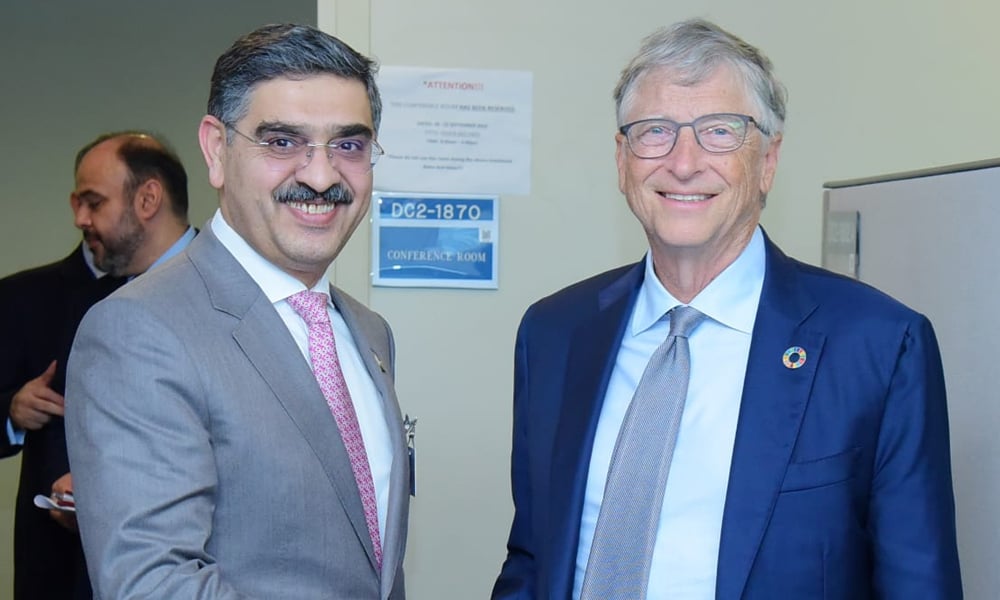
Pakistan’s caretaker prime minister and the Gates Foundation co-chair focused on eliminating poliovirus, improving nutrition and expanding financial inclusion, with particular attention to vulnerable communities and the challenge of cross-border transmission from Afghanistan.
By Saqib S. Qureshi
Senior Correspondent | A1 TV Pakistan
NEW YORK, Sept. 20, 2023 — Pakistan’s caretaker Prime Minister Anwaar-ul-Haq Kakar met Bill Gates, co-chair of the Bill & Melinda Gates Foundation, on the sidelines of the 78th United Nations General Assembly in New York, with talks focusing on Pakistan’s long-running battle to eradicate polio as well as nutrition, gender equality and financial inclusion. The meeting itself is confirmed by Pakistan’s state news agency, which photographed Kakar and Gates together in New York on September 20.
The encounter put one of Pakistan’s most persistent public-health challenges directly on Kakar’s UNGA agenda.
Despite decades of vaccination campaigns, Pakistan remained one of the few countries where wild poliovirus transmission had not been completely interrupted, making cooperation between the government, international health organizations and major donors crucial to the eradication effort.
Kakar told Gates that his caretaker government and Pakistan’s National Polio Task Force remained committed to reaching children with polio vaccines, routine immunizations and other essential health services.
He expressed optimism that Pakistan could stop transmission across the country. Contemporary reporting on the meeting said Gates, meanwhile, reiterated that eliminating polio in Pakistan remained a priority.
Afghanistan Border at Center of Polio Challenge
One of the most important dimensions of the discussion was the relationship between Pakistan and neighboring Afghanistan in the fight against polio.
Reporting on the meeting said Gates highlighted the importance of stopping cross-border poliovirus transmission between Pakistan and Afghanistan, while continuing vaccination efforts in Pakistan’s Khyber Pakhtunkhwa province.
The issue illustrates why polio eradication cannot be treated purely as a domestic Pakistani health campaign.
Population movement across the Pakistan-Afghanistan frontier means successful eradication efforts require coordination and sustained vaccination coverage on both sides.
For Pakistan, that makes border regions particularly important to the final stages of eradication.
Gates Backs Pakistan’s Polio Infrastructure
Gates also expressed confidence in Pakistan’s National Emergency Operations Centre and the caretaker government’s ability to continue efforts to interrupt poliovirus transmission, according to reporting at the time.
That support matters because the Gates Foundation has been a major international partner in the global campaign against polio.
Pakistan’s eradication effort involves an enormous logistical operation: reaching children repeatedly with vaccines, identifying areas where transmission persists and responding rapidly when environmental surveillance or clinical cases indicate that the virus remains in circulation.
The challenge becomes particularly difficult in communities affected by insecurity, population movement, vaccine hesitancy or limited access to healthcare.
Beyond Polio: Nutrition and Financial Inclusion
The Kakar-Gates meeting extended beyond vaccination.
The two discussed nutrition and financial inclusion, while contemporary reporting also identified gender equality as part of their talks.
Gates welcomed efforts to scale up approaches aimed at improving nutrition and expanding financial inclusion in Pakistan.
The discussion linked public health with a broader development challenge.
Poor nutrition can have lifelong consequences for children, while greater financial inclusion — particularly for women — can increase household economic resilience and access to essential services.
The two sides also discussed how progress in these areas could support women and girls by improving their ability to manage their health, finances and futures.
Meeting Led to Continued Kakar-Gates Engagement
The significance of the New York meeting became clearer over the following months.
On November 28, Gates called Kakar while the prime minister was visiting the United Arab Emirates. Pakistan’s government explicitly described that conversation as a follow-up to their September meeting on the sidelines of UNGA in New York.
During the November call, Kakar again reaffirmed Pakistan’s commitment to eliminating polio and briefed Gates on an ongoing vaccination campaign. Malnutrition and maternal health were also discussed.
Kakar told Gates that Pakistan wanted to build a healthier, safer and more financially inclusive country and described the Gates Foundation as an important partner in that effort.
Only days later, the relationship continued at COP28 in Dubai.
Kakar and Gates met again on December 2 and expanded their discussions to include financial inclusion, poverty alleviation, malnutrition, STEM education, disaster early-warning capabilities and digitalization of agricultural value chains.
That sequence shows the September UNGA encounter was not an isolated ceremonial meeting.
It helped establish an ongoing dialogue between Pakistan’s caretaker government and the Gates Foundation around health and development priorities.
Why the Meeting Mattered
Among Kakar’s UNGA side meetings, the encounter with Gates stood apart from traditional state-to-state diplomacy.
There were no negotiations over borders, defence agreements or geopolitical alliances.
Instead, the central question involved something more immediate: whether Pakistan could finally eliminate a disease that much of the world had already defeated.
The discussion also demonstrated that the country’s remaining development challenges were interconnected.
Polio eradication required functioning healthcare systems and access to vulnerable communities. Better nutrition was essential to children’s long-term development. Financial inclusion could strengthen families and particularly benefit women. And cross-border transmission meant Pakistan’s health security could not be separated completely from conditions in Afghanistan.
The New York meeting therefore represented a partnership built around measurable outcomes rather than diplomatic declarations.
For Kakar, the objective was a Pakistan free from poliovirus.
For Gates and his foundation, Pakistan remained one of the decisive remaining fronts in the global campaign to make that objective a reality.